Wednesday, August 20, 2014

Harvesting Onions

When ordering my seeds this past January I had a hard time deciding on what kind of onion plants to order for this year. So, like any good gardener, I decided to order more than I needed and plant three kinds of onions. To do this I ordered the Northern Bunch onion plant mix from Territorial Seed Company. The specific varieties in this bunch were Walla Walla (a yellow onion), Red Zeplin (a red onion), and Ringmaster (a white onion).

As promised in the seed catalog, the onion plants arrived at just about the right time for planting here in Wisconsin. The onion plants came in a small box containing 50 to 75 plants. I divided the plants into three groups - red, white, and yellow. I then prepared about a 20 foot long mounded row for planting. Each variety got about 6 to 7 feet of the row.

Onions shortly after planting
Now after many weeks, the onions are just about ready to be harvested. There are two ways to use the onions. The first way is to just simply go into the garden and pull an onion out for whatever you need in the kitchen. I have done that with my red onions this year and they are just about gone. They have been really good this year.

The second way to harvest the onions is to dry and store the onions. This is more work and you really need a proper place to dry and store them if you want success. I plan to do this with my white and yellow onions.

You will know when your onions are beginning to mature when the green stalk starts turning yellow or brown and falls over to lay on the ground. It is a good idea to speed up this process by bending the stalks over at the onions so they are laying on the ground. After a few days in this condition, use your spading fork and loosen the soil around the onion. The onions can then be pulled up and laid on top of the ground to begin the drying process.  Do this very gently since onions bruise easily.  Once they are bruised they become very susceptible to rot. To prevent sunscald, lay the onions out on the dirt such that the stalks of one onion cover the bulb of another onion. 

If you look closely at the onion stalk you will notice that it is made up of several smaller stalks. Each small single stalk is called a leaf. You will know if you have grown a mature onion if there are 13 leaves on the stalk at this time. 

Variety of white onion called Ringmaster

Variety of yellow onion, Walla Walla, beginning to fall over

When the tops are completely brown, the onions should be gathered up and laid out in a dry spot out of the sun. It is a good idea to lay the onions out on an elevated screen or mesh to allow air to circulate around them. The onions are ready for storage when the stalk is dried all the way down to the onion. If you pinch the stalk at the base it won't slide or feel soft. Also, the skin of the onion should take on a uniform texture and color.  Before storing, clip the roots and stalks off to within one inch of the bulb. The onions should be stored in a cool, dry and well ventilated space in a mesh bag.

I've read that sweeter onions tend to rot quckly so eat those up first. Finally, remember these words from the Farmers Almanac ....

Onion's skin very thin,
Mild winter coming in:
Onion's skin thick and rough,
Coming winter cold and rough.


Sunday, August 10, 2014

Veggies in a Flower Garden

I was in Chicago a couple weeks ago for a work conference.  At the end of the day I took a walk down to Millennium Park.  Check out the pictures of these flower beds.  Love the idea of growing corn, Swiss Chard and other vegetables in your flower garden. This makes for a really interesting flower garden from a color, variety, height and texture perspective. Would love to see Milwaukee do something like this in their public gardens. I am going to try growing corn in my flower garden next year for sure.


Sunday, August 3, 2014

Cracked Tomatoes


I thought it would be good to talk about a condition with your tomato plants you might have this year. The condition is called tomato cracking or split tomato. Here is a picture of what the condition looks like.

The split tomato is really caused by a lack of water. What happens is that in a dry spell or if you don't water consistently, the tomato can dry out and crack. The tomato needs water to stay juicy and lush. When you water again or it rains, the tomato takes in the water and splits at the spot where it had previously cracked. Kind of like overfilling a water balloon.

In addition to an aesthetic issue, the crack in the tomato can allow bacteria and fungus to enter the plant so it is important to water your tomatoes properly.

Tomatoes should receive one to two inches of water per week. This water should be provided on a regular and even basis. Don't forget to use mulch to help keep the soil moist and disease in check. Finally, if you go on vacation ask your neighbor to help water. Most people will gladly water for you in exchange for some tomatoes.

Sunday, July 27, 2014

Tomatoes and End of July Garden Update

It is interesting to look at your garden and where it is compared to other people's gardens.  For example, my cucumbers are only about an inch long at this point. When I looked at Facebook the other day, I saw one of my gardening friends had already made pickles from cucumbers she harvested in her garden. Clearly, the cold weather by the lake has done no favors to warm weather loving plants like cucumbers.

How are your tomatoes doing?  Do they have any funny looking leaves on them? Have they set tomatoes yet? I have several plants with tiny tomatoes on them so I am a ways off from harvesting any tomatoes. However, the other day I noticed some yellow and brown leaves on the lower part of some of my tomato plants.  Here is what they looked like.


Anytime you see something like this you know something is wrong and action needs to be taken right away.  Problems can develop overnight with your plants and then get out of hand very fast. At this point, you have worked too hard to have something decimate your plants now. While these are not good signs for a tomato plant, if acted upon quickly it is nothing to get too alarmed about. My action, of course, was in the form of an internet search. I Googled images of tomato diseases. You get some pretty crazy looking stuff but after looking at several websites I determined that my plants had some kind of fungus. To me it looks like a fungus called Septoria or Early Blight. These are very common issues especially with the wet spring and summer we have had up until recently. I immediately went back to the garden and clipped all the stems off with any issues on them. I then put these infected stems in the GARBAGE.  I did NOT put these into the compost pile. Putting them in the compost pile means that the fungus will keep living and will reappear when I apply that compost at a later time.  Next, I added some mulch to the area underneath my tomatoes.  This will help keep moisture off the plant leaves. The most important thing to do is to bottom water your tomatoes so the water from your sprinkler does NOT touch the leaves. All these actions will help create a drier environment that is not conducive to fungus. Pretty sure I will move my tomato plants to a different part of the garden next year as well, just to make sure.

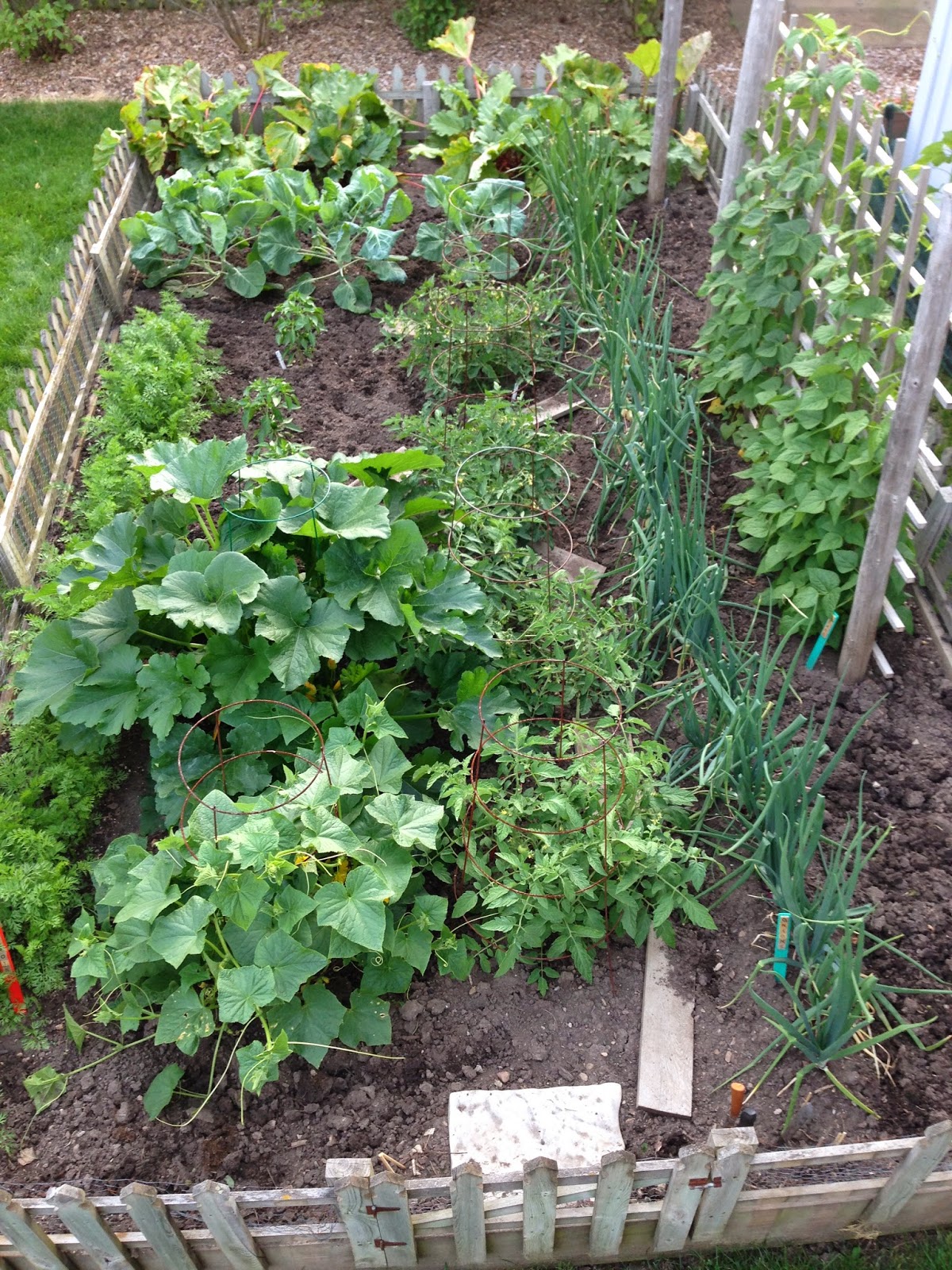
My yellow squash are coming in nicely and I actually got to harvest ONE of them last week.  The carrots are really doing well.  So well in fact, that if I wanted to I could harvest some.  Probably should do that since they are so sweet early on like this. In the past I have tried to stagger the harvest of my carrots. If you watch for rot in your carrots and keep them watered, the ground acts as a natural storage container. I have done this so late into the fall that I have had to cover them up with a blanket to protect them from frost. It is awesome to be able to go grab a couple carrots in October. I finally pulled my lettuce out.  I had gotten at least four cuttings from this planting so it was time to get the space ready for fall lettuce.  I will keep the area tilled, fertilize it once, and then finally layer it with some compost from my compost bin. After it rests for a bit like this it will be ready for a mid to late August lettuce seed planting. As you can see in the pictures the beans are really growing and have plenty of flowers on them. The onions are still growing with no signs of being ready to harvest.

Here are some pictures of my garden at the end of last week.


Sunday, July 20, 2014

Random Garden Stuff

Now this is a rain gauge. I saw this at Cedarburg's flea market last weekend and thought it would be a great addition to my garden. The vendor didn't have a price on it so I asked her about it. She said she was thinking $18. I said thanks and left because I really didn't think I could get her anywhere under $10, which I thought would be fair. The great thing is that I had the flea market pro haggler with me - my wife Lisa. So after a bit, I sent her over there to cut the deal as I hid a couple rows away.  Sure enough, Lisa got it for $8.  The funny thing is that when Lisa asked her what she wanted for the rain gauge the vendor tells her $10 and Lisa talks her down to $8. Really? $18 to $8 in a matter of a half hour. Anyway, check out the detail on this rain gauge. The information about the co-op is really neat and it is made out of metal. What is up with that phone number?


This picture is proof you can have a garden just about anywhere you want. I saw this when I was kayaking this weekend.  This person had potatoes, tomatoes and peppers in his pots. Seems like a good way to keep deer out of your garden.


Sunday, July 13, 2014

Summer Is Kicking In

Alright, now we are getting somewhere. The weather has finally started to cooperate for summer vegetables. The tomatoes are growing very nicely and with small tomatoes on some plants. I see a few yellow squash starting and the carrots are just really taking off. Weeds love this weather as well, so you really need to stay after them. They can get out of hand really quickly.

Notice the gap in the first two posts.  My peas were supposed to be there.


The onions are growing very well too. They look like spiky grass right now but pretty soon they will begin to flop over and harvest time will begin.


Its funny because as bad as this weather has been for some heat loving vegetables, it has been excellent for other vegetables.  I really can't remember a better season for growing lettuce.  I am on my third cutting of lettuce. Usually by this time of year the hot and humid weather has taken its toll on most lettuce varieties and they just don't grow well.  Here is a picture of my lettuce before I get ready to harvest it tomorrow morning. It is always best to harvest your lettuce before the sun starts hitting it.  Did you know that lettuce is a member of the sunflower family?

Lettuce ready for harvest
Gardeners are always thinking ahead.  They can't help but think about what they will change for next year and what needs to be planted soon. I sometimes think gardeners are never happy with the way their flower and vegetable beds look. They always think there is another kind of flower or vegetable to add or a plant that needs to be moved to a better location. Right now I am starting to think about what kind of vegetables I need to plant now for fall harvest. The one item I really want to get in within the next week or so are my peas. If you remember I was robbed of peas this summer when my local rabbit got into my garden and ate all my peas. The first average frost date in Milwaukee is about October 20th.  I think it might be a bit later than that along the lake but you never know.  With that October date in mind, I need to get my peas in the ground within the next week or two.  Hopefully, the local rabbit has moved on.

I think I may have beaten the cut worms for this season.  I suppose I might need to worry about the deer at this point.  Oh well, here is a picture of my sunflowers.


Here are a couple pictures of my perennial flower bed.  My clematis that I planted last year are loaded with flowers but I need to add some more plants. See? Always something to do.


Friday, July 4, 2014

Garden Update

All that hard work this spring and early summer in the garden is suppose to be paying off now. Not this year. It is just flat out frustrating and everything is just so slow to grow. Rain, clouds, fog and cool weather by the lake have not been good. We so need a couple weeks of sunny and 80 degree weather.

I look at my garden every morning before work and then again every night after work. Nothing seems to be growing. I'm probably looking at it too much so nothing is changing in my mind. I clearly just need to leave it alone for awhile but I keep thinking of fresh tomatoes and carrots.

Now, having said all that, my potatoes are growing like crazy.  These are the potatoes I am growing in the Smart Pots. I have previously written about these back in my May 18th post. These bags have really worked well.  They don't seem to dry out fast and they have been very durable.

Potatoes taking over!

Yes, blossoms!

While I'm waiting for my vegetable garden to grow I have several other projects to do in the yard. There are several bushes that need trimming, Lilac blossoms to cut off, perennial flowers are taking off and need trimming and there are always weeds to pull. Just when you think you can relax as a gardener there is something to do.

Gardening requires such calmness, patience and understanding.

Here are some pictures of my garden from last week.

Long row of carrots

Onions are cranking and beans on the right are climbing!


Still having trouble with cut worms